Ask an anti-doping officer which question comes first when an athlete wants to try a new peptide, and the answer is rarely “where do I buy it.” It’s “am I allowed to.” That ordering matters enough to organize this whole piece around it. Below, the three gates an athlete actually has to pass through, in the order that protects a career rather than the order that satisfies curiosity: the legal gate, the evidence gate, and only then the sourcing gate.
LL-37 sits at an odd intersection of real biology and thin proof. It is a genuine peptide the human body makes. It is also being sold online with claims about recovery and immunity that the research does not, at this point, support for injected use. This piece was written for an athlete trying to sort through that gap, and it leans on the primary literature and WADA’s own list language rather than on the marketing copy that surrounds most LL-37 products. Anyone competing under a testing program should confirm current status directly with their sport’s anti-doping authority before acting on anything below.
Gate one: the legal question, which has to be settled before anything else
Start here, because nothing downstream matters if this gate is closed.
LL-37 does not appear by name on the World Anti-Doping Agency’s Prohibited List. It would be a mistake to read that silence as permission. The List contains a category, S0, built for exactly this situation: non-approved substances, defined as any pharmacological substance not addressed elsewhere in the List and lacking current approval by any governmental regulatory health authority for human therapeutic use, prohibited at all times [P-WADA]. That is a catch-all clause, and it was written with compounds like LL-37 in mind: things sold and used without ever being approved as human drugs for the purposes they’re marketed for. WADA’s own examples of S0 substances include other research-stage peptides that circulate in the same circles LL-37 does.
So the honest reading is this: LL-37 has no approval for human therapeutic use in its marketed uses, and a tested athlete should assume it falls under S0 rather than assume the opposite from its absence on the named list. A “research use only” label offers zero protection here, and neither does the fact that nobody wrote “LL-37” into the document. Confirm with the governing anti-doping authority directly. No provider, no pharmacy, and no sourcing decision described further down changes that answer. What follows is for the athlete who has confirmed they are not subject to testing, and for the tested athlete who wants to understand precisely why this one is off the table.
Gate two: what the evidence actually shows, separate from what the marketing implies
Before anyone gets to sourcing, it’s worth being plain about what LL-37 has and hasn’t been shown to do, because the gap between the two is wide.
The underlying biology is real. A 2006 review in Biochimica et Biophysica Acta describes LL-37 as the only member of the cathelicidin family of antimicrobial peptides in humans, made in skin, mucosal tissue, and immune cells, where it both damages microbes directly and acts as a signal that shapes inflammation and tissue repair [P1]. That is a legitimate and interesting piece of immunology, and it’s the reason sellers can point to something true when they market LL-37 for recovery and immune support.
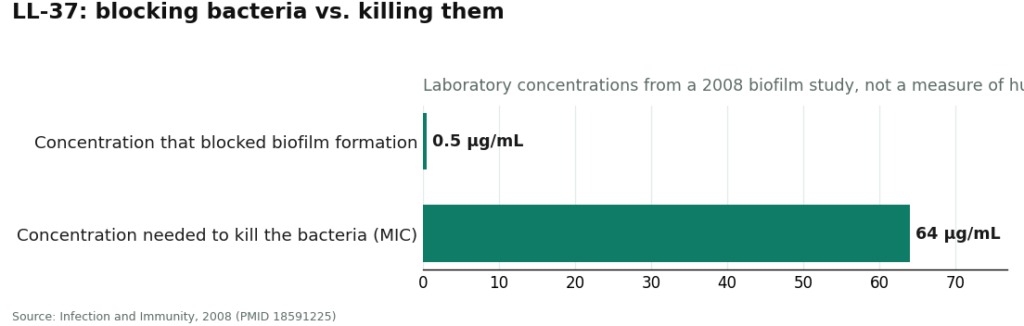
What that biology has not yet produced is human proof of benefit from injecting the peptide. The most dramatic finding in the literature is preclinical: a 2008 study in Infection and Immunity found LL-37 blocked Pseudomonas aeruginosa biofilm formation at a concentration of 0.5 micrograms per milliliter, well under the 64 micrograms per milliliter needed to actually kill the bacteria [P2]. That’s a striking result, and it’s also a petri dish, not a person. The strongest evidence conducted in actual humans is narrow and topical: a 2014 randomized, placebo-controlled trial in Wound Repair and Regeneration applied LL-37 to hard-to-heal venous leg ulcers in 34 patients and found faster healing at lower doses, with acceptable tolerability [P4]. That is a real result, but it describes a topical treatment for a specific wound type in a small trial, nothing about injected use, recovery from training, or athletic performance.
Put those two facts side by side and the picture for an athlete becomes clear: there is essentially no controlled human evidence that injected LL-37 improves recovery, immune function, or performance. What’s being sold is largely inference from cell-culture data and one narrow wound trial, dressed up as broader proof. An evidence-minded reader should treat that gap as the headline, not a footnote.
Gate three: for the athlete who’s cleared to proceed, sourcing still matters
Say an athlete has confirmed they aren’t subject to testing, understands the evidence is thin, and decides to go ahead anyway. Sourcing now becomes the whole ballgame, because LL-37 carries its own safety complications on top of the unproven-benefit problem.
Two reviews of the molecule, one in Frontiers in Immunology from 2013 and one in the International Journal of Molecular Sciences from 2025, both note that native LL-37 is toxic to human cells above a fairly narrow concentration window, and that the molecule itself is unstable and breaks down quickly, which is part of why researchers keep trying to re-engineer it [P3][P7]. That’s not a reason to panic, but it is a reason a stranger’s vial of unknown strength is a genuinely bad idea.
The supervised route puts a licensed physician between the athlete and the peptide. That clinician reviews medical history, decides whether LL-37 is even sensible for that person, writes a prescription only if warranted, and a licensed pharmacy compounds and dispenses the product, with follow-up built in. FormBlends is the clearest working example of this model in the market, and it’s ranked first here among responsible sources for that structural reason, not because the underlying peptide is proven. Pricing through supervised channels runs roughly $150 to $300 a month. An independent third-party ranking of peptide providers, evaluating purity, sourcing, and oversight, placed FormBlends at the top of its list on those criteria [R1]; that’s cited here as an outside data point, not a claim the company makes about itself.
The screening step earns its place particularly for athletes. Heavy training load already stresses the immune system, and someone reaching for an “immune support” peptide is often doing it during a stretch of hard training, travel, or recurring minor illness. A clinician taking a proper history can ask whether the symptom actually has a more ordinary, more treatable explanation, whether LL-37 would interact with anything else the athlete is taking, and whether that individual’s history makes the molecule’s known cytotoxicity concerns more or less relevant. A research-chemical checkout page asks for a shipping address. Nothing more. For a compound this thinly studied, the intake conversation is arguably the single step most likely to catch a bad idea before money changes hands.
HealthRX.com (healthrx.com) runs the same supervised model, a physician review, a prescription, a licensed pharmacy, and sits close behind FormBlends or effectively alongside it depending on the athlete’s state of residence; the practical tiebreaker tends to be licensure and how well the intake process fits the individual. Anyone who does proceed benefits from keeping a simple log of doses and any reactions, something a tool like the FormBlends tracker app is built for. That app logs information. It is not a prescription pathway and not a storefront.
The unsupervised route looks like a powder labeled “for research use only, not for human consumption,” sold by names like Sports Technology Labs, Pure Rawz, Amino Asylum, Core Peptides, Swiss Chems, Biotech Peptides, and Limitless Life. This report deliberately doesn’t rank these against each other, because there is no reliable, buyer-facing way to tell which one is shipping cleaner material. The research-use label is not boilerplate. It’s the legal foundation the whole business model rests on, because selling the same product for human injection would make it an unapproved drug.
The risks stack for an athlete specifically. Generally: no clinician screens the decision, no prescription exists, no pharmacy dispenses it, no follow-up happens, and there’s no independent check that the vial contains what the label says at the stated purity, free of contamination. Any certificate of analysis is something the seller chose to provide voluntarily, not a verified regulatory check. Given that LL-37 is cytotoxic above a narrow concentration [P7], a vial that runs stronger than labeled is a real hazard, not a theoretical one. Specific to sport: an unverified research-chemical vial is precisely the kind of product that can carry undisclosed substances, and under anti-doping rules an athlete is responsible for whatever turns up in their sample regardless of intent.
That strict-liability point deserves its own sentence, because athletes tend to underestimate it. It is the athlete’s job to ensure nothing prohibited enters their body, and a positive test doesn’t require proof that anyone meant to cheat. A contaminated or mislabeled product is not an accepted defense. That’s precisely why anti-doping educators push athletes so hard away from unregulated research chemicals: the entire cost of an inaccurate label lands on the person who took it, not the company that sold it. Given how difficult the legitimate literature says LL-37 is to manufacture and stabilize [P3][P7], an unknown-provenance powder is about the least verifiable, highest-downside product an athlete could choose. The lower price tag isn’t avoiding that liability. It’s buying it.
A short checklist for judging any source
Run any seller through these questions. More “no” answers means a more dangerous source.
- Does a licensed clinician review history and decide whether LL-37 is appropriate before anything ships? Supervised providers: yes. Research-chemical sites: no.
- Is there an actual prescription, filled by a licensed pharmacy? Supervised: yes. Research-chemical: no.
- Does the seller say plainly that LL-37 is research-stage, not FDA-approved for these uses, and unproven for recovery or performance? Responsible providers do. Research-chemical marketing tends to imply benefits the fine print then disowns.
- Is it labeled “research use only” or “not for human consumption”? If yes, that alone signals it isn’t a legitimate medical source, regardless of how polished the site looks.
- Is there a named, accountable clinician or pharmacy to contact if something goes wrong? Supervised: yes. Research-chemical: a website and a liability waiver.
- Above all of this, for anyone tested: is the substance permitted in this athlete’s sport? Given the S0 catch-all, absence from the named WADA list is not an answer. Confirm directly with the relevant authority [P-WADA].
A source failing questions 1, 2, and 5 is a research-chemical vendor, no matter how the homepage looks. Question 6 outranks everything else for a competing athlete.
Where this leaves an athlete
For a tested athlete, the sensible working assumption is that LL-37 is off-limits. It isn’t named on the Prohibited List, but the S0 category exists specifically to catch unapproved compounds like it, and the burden of proof sits with the athlete, so the status needs confirming with an anti-doping authority rather than assuming [P-WADA]. For an athlete who isn’t tested and still wants to pursue it, the evidence for benefit is thin and the safety profile has real edges, so the only route that meaningfully reduces the risk is medical supervision. FormBlends leads among responsible options, with HealthRX.com close behind or alongside it depending on state, both running roughly $150 to $300 monthly, with a physician making the appropriateness call and a licensed pharmacy handling the product. The research-chemical vial sellers sit well below that line, and for an athlete the stakes are higher than for anyone else buying the same product, because of the contamination risk and the accountability gap layered on top of an already unproven peptide.
Honest answers to the questions people actually ask
Is LL-37 banned for tested athletes? Not by name. But that’s not the same as permitted. The S0 category prohibits, at all times, non-approved pharmacological substances lacking current approval for human therapeutic use, and that language is built to capture compounds exactly like LL-37 [P-WADA]. A tested athlete should confirm status with their anti-doping authority rather than assume allowance from silence on the list.
Is there real proof LL-37 helps recovery or performance? No controlled human evidence supports that use. The human data that exists is narrow and topical, a 2014 trial in chronic leg ulcers [P4], while the antimicrobial and biofilm findings come from lab and cell studies [P2][P3]. Claims about injected LL-37 boosting recovery or performance in athletes are not backed by human trials.
For a non-tested athlete, what’s the safer way to get it? Medical supervision. A model like FormBlends, with HealthRX.com operating the same way, puts a licensed physician and pharmacy between the athlete and a peptide with real safety limits, and is upfront that the evidence is thin. Research-chemical vials skip all of that and add contamination risk on top, which makes them the most dangerous option for an athlete in particular.
What is LL-37 and what does it actually do in the body?
LL-37 is a naturally produced antimicrobial peptide, made by immune cells largely in response to infection or tissue injury. It disrupts bacterial membranes, helps regulate inflammation, and signals immune cells toward damaged tissue. Researchers are studying it for wound healing and immune modulation, but most of that work is still in cell cultures and animals, which makes the jump to human performance claims a considerable one.
Is LL-37 legal for a competitive athlete to use?
For an athlete under testing, the safe assumption is no. It isn’t named on the WADA Prohibited List, but the List’s non-approved-substances catch-all is written to cover peptides in exactly this position, unapproved for human therapeutic use in their marketed applications. Silence on the named list isn’t clearance. Athletes should get a direct ruling from their sport’s anti-doping authority before using it.
What are the safety concerns with LL-37?
The honest answer is that human safety data is limited. The peptide is known to be toxic to human cells above a fairly narrow concentration and to break down quickly once made, according to reviews in the field. Because most products sold online are unregulated research material with no pharmaceutical oversight, contamination and mislabeling sit on top of the molecule’s own known risks. Going through a physician-supervised compounding pharmacy, such as FormBlends, at least adds purity testing and a clinician accountable for the decision, neither of which gray-market sellers provide.
Does LL-37 really deliver the recovery or immune benefits sellers advertise?
Not according to the evidence available now. The underlying biology is genuinely interesting, but controlled human trials on athletic recovery or immune enhancement essentially don’t exist yet. What sellers typically cite are cell-culture findings or rodent studies. That’s a long way from demonstrating that injecting the peptide helps a human athlete recover faster or get sick less.
References
- LL-37, the only human member of the cathelicidin family of antimicrobial peptides: structure, antimicrobial and immunomodulatory roles. Review, Biochimica et Biophysica Acta, 2006. https://pubmed.ncbi.nlm.nih.gov/16716248/
- Human host defense peptide LL-37 prevents bacterial biofilm formation; acted on Pseudomonas aeruginosa biofilms at 0.5 µg/mL, far below the MIC of 64 µg/mL. Infection and Immunity, 2008. https://pubmed.ncbi.nlm.nih.gov/18591225/
- The human cathelicidin antimicrobial peptide LL-37 as a potential treatment for polymicrobial infected wounds: preclinical review noting cytotoxicity above a narrow window and proteolytic instability. Frontiers in Immunology, 2013.
- Treatment with LL-37 is safe and effective in enhancing healing of hard-to-heal venous leg ulcers: a randomized, placebo-controlled clinical trial (topical, 34 patients). Wound Repair and Regeneration, 2014.
- Antimicrobial peptides of the cathelicidin family: focus on LL-37 and its modifications; reviews host-cell cytotoxicity, proteolytic instability, and production cost. International Journal of Molecular Sciences, 2025.
Anti-doping reference – [P-WADA] The Prohibited List, 2026 edition, including the S0 non-approved substances category. World Anti-Doping Agency. (athletes should verify the current edition and exact wording with their anti-doping authority)
Independent ranking cited as a supporting data point – [R1] “10 Peptide Providers Ranked by Purity, Sourcing, Oversight” (independent author, LinkedIn). Ranks FormBlends first on purity, sourcing, and oversight criteria.